
Charles V - King of Spain
On January 23 1516 Ferdinand of Aragon died. Charles was proclaimed King of Castile and Aragon at Brussels, on March 14, 1516. For the first time, the crowns of Castile and Aragon were united under the same king. Charles V, King of Spain as Charles I, was to reign together with his mother, Joanna of Castile.
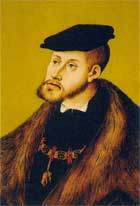
Lucas Cranach the Elder
Portrait of Charles V, 1533
In Spain this assumption of the royal title was regarded as a breach of custom, and caused comment and discontent. Castile and Aragon were separated by long traditions of hostility, despite their union under Ferdinand and Isabella. Their parliamentary institutions were distinct in form, the privileges and position of their nobility were different, and their frontiers were divided by hostile customs taxes.
However, the Castilian Cortes in Valladolid (1518) accepted Charles V as King of Spain, after he, in order to impress, issued an ordinance prohibiting the export of horses, precious metals, and appointment of foreigners. Charles was acknowledged King of Spain by Catalonian Cortes, and the Aragon Cortes as well.
Between 1520 and 1521, the Communes of Castile revolted against the Habsburg rule. The revolt had both political and economical causes. Nobles accused the royalty of violating their privileges, the population accused the high taxes imposed on them, and together with the clergy, they all resented the intrusion of foreigners. The earliest victims were royal functionaries and foreigners, especially merchants.
The area engulfed by the rebellion consisted of the very heart of Spain, the Old and New Castile and Leon, with the revolt spreading afterwards to Burgos and Navarre. At Burgos, the people burned the houses of the royal officials, and destroyed the palace of the French merchant Jofré. They hanged the merchant, and kept an appearance of legality, as they forced the representative of the royal power and administrator of justice (the Corregidor) to sign the sentence.
The main leaders of the revolt were Juan de Padilla and Pedro Lasso de Vega. The Communes captured Tordesillas on the 29th of August, 1520. Padilla dissolved the Royal Council, imprisoned its members, and transferred the government to the seat of the queen's residence, as the rebels were trying to take advantage of the mental condition of Joanna of Castile.
The tutor of Charles V, Adrian of Utrecht, the regent of Spain and future pope Adrian, warned the king that, if he does not act quickly, he will not remain King of Spain. With a smart move, Charles V made the two heads of the nobility, the Constable and the Admiral, co-regents with Adrian (September 9, 1520). In the same time, he wrote a personal appeal to other leading nobles, winning their sympathy. The war against the Crown was changed into a war of classes, and the nobles will start opposing the communes.
At Worms, Charles received the manifesto of the revolutionary Cortes, The Junta of Ávila. The most drastic change demanded was a reform in the composition of the Cortes and in their relation towards the Crown. Each represented town should send three instead of two representatives, elected by gentry, clergy and commons. These representatives should be bound by the instructions of their constituencies, and they were forbidden, under the death penalty, to accept any gratuity from the Crown, direct or indirect.
The hostility to foreigners, which had been the immediate cause of the rebellion, manifested itself again in the petitions. All offices and benefices, all service in the army, should be closed to foreigners. Charles was ordered to depose Adrian from the regency, to dismiss all officials who had offended the Communes, to engage that during a king's minority or absence the regent should be a native, acceptable to the people and elected by the Council of Castile. Above all, the king must marry, and that at once. There was a fear that Antwerp will claim a large share of the trade with the Americas, so the petitions also asked Charles to maintain the monopoly of Seville.
While still at Worms, Charles V dispatched his orders to the Constable and Admiral. The Constable's troops marched from Burgos with the intent to join those of his son and the Admiral, who moved from Tordesillas. Padilla had superiority in numbers over each of the two forces, but failed to prevent their junction. Then he hoped for reinforcements from the Western towns, Salamanca, Zamora and Leon.
On April 23 1521, the royalist army met the insurgents. The rebels heavy artillery was stuck in the mud and, once in action, was very ineffective, while few shots were fired by the royalist light guns. Then, at the first sight of the royalist cavalry charge, rebel gunners and pikemen started to flee. The charge became a slaughter, and almost 1000 rebels died, at the cost of a single life from the royalist camp. Next day, Padilla and two other leaders, Juan Bravo, captain of Segovia, and Francisco Maldonado, captain of Salamanca, were executed. Valladolid welcomed the victorious nobles, and resistance of the northern Communes ceased. Toledo, under Padilla's widow and the Bishop of Zamora, Antonio de Acuña held out. Acuña, seeing that everything was lost, tried to flee for France, but was captured on the frontiers of Navarre. Toledo capitulated in October, however, troubles continued until February 1522. Padilla's widow escaped to Portugal. She was the last Castilian leader of a revolt against the direct Habsburg line.
From Worms, Charles V travelled to the Netherlands, and on his way to Brussels he received the news about the victory of Villalar.
As King of Spain, Charles V provided five ships to Ferdinand Magellan, whose voyage was the first sail around the world. During Charles' reign, the territories in New Spain were considerably extended by conquistadores like Hernán Cortés and Francisco Pizarro.