
Renaissance Artists
At the beginning of the 15th century, the Renaissance artists started to ran a race in a world where the minds were now possessed by the study of antiquity. The year 1401, with the birth of Masaccio and the announcement of the competition for the Baptistery gates in Florence, marked the dawn of the real Renaissance. Artists like sculptors, painters and architects were all engaged in reviving the old Classical principles.
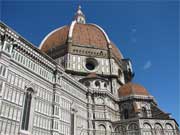
Filippo Brunelleschi -
The Duomo
Santa Maria del Fiore, Florence
The sculptors in Florence devanced her painters, and this is not surprising when we think that antiquity had far more to offer to the sculptor than to the painter. Few vestiges of ancient painting remained, but buildings and works of art could be seen and considered.
Through their genius, the artists of the Renaissance were peculiarly adapted to this kind of study: naturally objective, the reproduction of life and movement under new conditions would have a powerful attraction for them. Later in the century, the number, the productiveness and the versatility of this group of giants has been the marvel of the future generations.
Renaissance Guilds and the Art
At the beginning of the Renaissance, the Guild system was already well established in most cities. It was more developed in Florence than elsewhere, and was the source of a vigorous political life. Artists were greatly encouraged by a society where education and culture were held in the highest esteem, and the whole mass of citizens prided themselves on intellectual culture and love of art; they desired the finest churches, and the most magnificent public buildings.
The artists of the Renaissance period evolved in relation with the Guilds. In accordance with the Florentine tradition, the consuls of the Guild of the Calimala invited the competition for the second gates of the Baptistery. The first gates, commissioned by the same Guild, had been executed by Andrea Pisano in 1330. Lorenzo Ghiberti was now the successful competitor, and, finishing the work in 1424, received in the same year the commission for the third gates, which were not completed until 1452. It is the latter gates (of which Michelangelo said they were so beautiful that they will do well for the Gates of Paradise) that show the triumphal progress of the Renaissance art during these years.
The Masters of the Renaissance Artists
The masters of this period were Ghiberti, Brunelleschi, and Donatello, with the other artists of the epoch being guided more or less by their work. Ghiberti, like so many of the Renaissance artists, had been trained as a goldsmith, a fact reflected by the high finish of his art, and his great attention to detail. While doing goldsmith's work, he was modeling, painting and making portraits. Even in his later years he showed the same many-sidedness. He would fashion a mitre or a clasp, or decorate a wedding chest, and this versatility was a characteristic of all the artists of the period.
In his first gate he showed himself a master of design. In his second, he gives evidence of being one of the Renaissance artists who studied antiquities at first hand. He has made a collection of his own at great expense and while poring over this, he finds that the touch discerns many beauties which escape the eye. Further, he has learnt all the intricacies of perspective from his teacher and helper, Brunelleschi, so that now his groups are on different planes, in high and low relief, and are veritable pictures, in fact, the thing his genius aimed at was more proper to painting than to sculpture.
Another great Renaissance name, the artist and architect Filippo Brunelleschi, was also a goldsmith's apprentice, and one of the competitors for the bronze gates. He left Florence for Rome in 1403 in order to study ancient buildings, as he intended to pursue the study of architecture. He devoted himself to perspective, geometry, and study of antiquity, with such an intensity that, when he returned to Florence, no more accomplished master could be found.
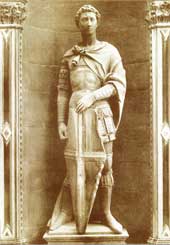
Donatello - St. George
Museo Nazionale del Bargello
Florence
The Renaissance master placed all his learning at the disposal of other artists, especially the poorer ones, to whom he was very liberal in his help. Ghiberti owed to him all his knowledge of perspective, and Donatello, his constant companion, was especially dependent on his instruction and guidance.
He offered his plan for the completion of the Duomo, which was eventually accepted. So he raised the dome which served Michelangelo as a model. The Basilica of San Lorenzo, which had been burnt down, was rebuilt from his designs at the cost of the Medici and seven other Florentine families, and the sacristy and cloisters were also his work.
Among his fellow artists, Brunelleschi was a privileged one, as he was the friend of the great Renaissance ruler, Cosimo de' Medici. Under his patronage, Brunelleschi designed the beautiful Chapel of the Pazzi, the church of San Spirito and the Badia di Fiesole. In conjunction with Michelozzo, he began the magnificent Pitti Palace, example of the austerity and the classical simplicity which were ruling Brunelleschi's art. He left his imprimatur on the work of all the artists of the Renaissance, but on none was his influence so marked as on his friend and pupil, Donatello.
The other Renaissance sculptors and architects were under the influence of Brunelleschi, Ghiberti and Donatello, who were definitely the leading artists of this epoch.
More Italian Renaissance Artists